Spaces of Crisis and Critique by David Hancock Anthony Faramelli and Robert G. White
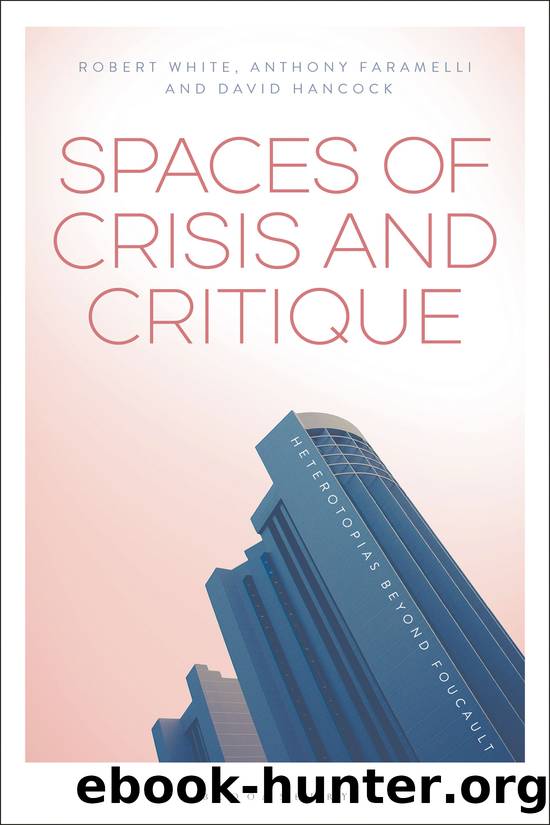
Author:David Hancock, Anthony Faramelli, and Robert G. White
Language: eng
Format: epub
Publisher: Bloomsbury Publishing Plc
5
The politics of the hidden space: Georges Bataille and non-knowledge in the era of transparency
David Hancock
We live in an era of transparency. Openness and visibility are taken as absolute goods and a cornerstone of the democratic system. The opposites, secrecy, invisibility, and hiddenness are received with suspicion. The doctrine of open government holds that the public has the right to access state documents and proceedings and to monitor the processes of the state, and Freedom of Information Acts now gives citizens the right to access information held by public bodies. Surveillance in urban areas is now ubiquitous. Through the revolution in digital technology, vast amounts of personal information are now willingly shared and even more is collected. Within this context the citizen is also subject to the regime of transparency. Security services have taken advantage of technological change and, enabled by law, now routinely collect and monitor electronic communications. This monitoring is done in the name of national security and through a logic of âif you have nothing to hide, you have nothing to worry aboutâ. Being open in this sense is taken as a sign of oneâs respectability while closing oneâs self off from the public gaze is to attract curiosity and suspicion. Transparency, furthermore, is taken as a prerequisite of a market society that functions on equality of access to information. Asymmetric information is understood to distort market mechanisms to which transparency is the answer to make a free market efficient. Data, through which the minutiae of life is coded, has become a basic commodity of the platforms upon which twenty-first-century capitalism sit, on what is fast becoming an unassailable position over social life.
This chapter considers the heterotopian promise of the hidden space as something other to the neoliberal regime of transparency. Through an analysis of the ontology of the secret, and what the philosopher Georges Bataille called the experience of non-knowledge, this chapter proposes the habitation of hidden spaces as part of the acceptance of the paradigm of non-knowledge. The experience of non-knowledge is described by Bataille as viscerally uncomfortable, and I will argue that it through occupying this space that we can remove ourselves from neoliberal reason, and the regime of digital transparency. This might not mean complete removal of oneself from the visible world but an occupation of a space that is both seen and unseen. Accepting a fundamental non-knowledge through such an occupation of digital space is, I argue, an attempt to move beyond the logic of modernity, the attendant logic of transparency and the law of economic reason.
Transparency in the digital space
The concern of some over surveillance is more than matched by the curious ambivalence and acceptance of the many, particularly in the digital space. For years millions of people have freely given the details of their weekly shopping to the supermarkets. Shopping centres like Londonâs Westfield now offer customers the opportunity to download apps that collate preferences so as to micro-target promotions while they shop. Since the advent of social media millions
Download
This site does not store any files on its server. We only index and link to content provided by other sites. Please contact the content providers to delete copyright contents if any and email us, we'll remove relevant links or contents immediately.
| Anthropology | Archaeology |
| Philosophy | Politics & Government |
| Social Sciences | Sociology |
| Women's Studies |
Cecilia; Or, Memoirs of an Heiress — Volume 1 by Fanny Burney(32558)
The Great Music City by Andrea Baker(32018)
Cecilia; Or, Memoirs of an Heiress — Volume 2 by Fanny Burney(31956)
Cecilia; Or, Memoirs of an Heiress — Volume 3 by Fanny Burney(31941)
We're Going to Need More Wine by Gabrielle Union(19046)
All the Missing Girls by Megan Miranda(16027)
Pimp by Iceberg Slim(14506)
For the Love of Europe by Rick Steves(14121)
Bombshells: Glamour Girls of a Lifetime by Sullivan Steve(14075)
Talking to Strangers by Malcolm Gladwell(13370)
Norse Mythology by Gaiman Neil(13363)
Fifty Shades Freed by E L James(13240)
Mindhunter: Inside the FBI's Elite Serial Crime Unit by John E. Douglas & Mark Olshaker(9343)
Crazy Rich Asians by Kevin Kwan(9292)
The Lost Art of Listening by Michael P. Nichols(7506)
Enlightenment Now: The Case for Reason, Science, Humanism, and Progress by Steven Pinker(7313)
The Four Agreements by Don Miguel Ruiz(6765)
Bad Blood by John Carreyrou(6621)
Weapons of Math Destruction by Cathy O'Neil(6279)
